



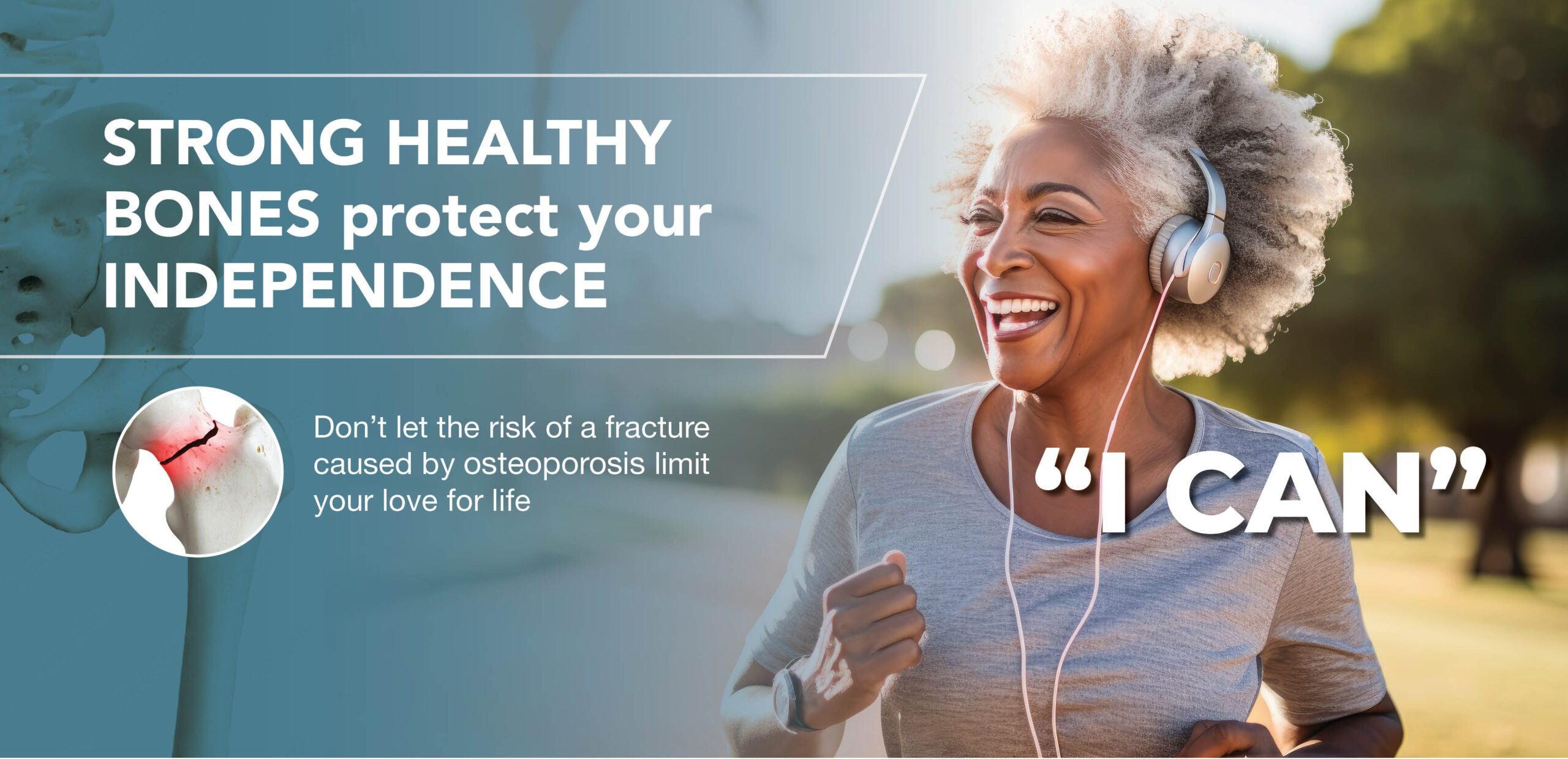
Check your risk factors for osteoporosis and download a guide with questions to ask your doctor.
Check your risk factors for osteoporosis and download a guide with questions to ask your doctor.



Yes, you CAN protect and regain your independence
Osteoporosis
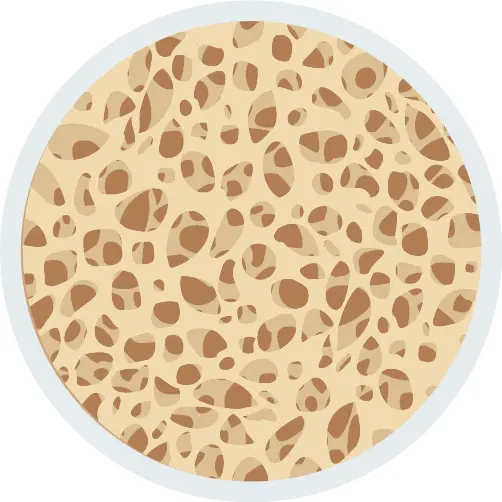
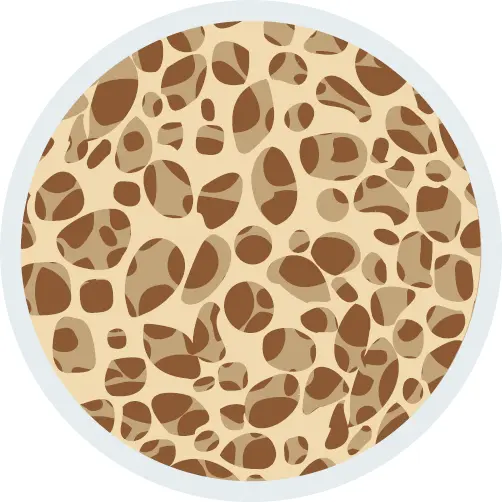
Osteoporosis is a disease that makes bones fragile and weak, increasing the risk of a fracture (broken bone). Osteoporosis is often referred to as a ‘silent’ disease because many people do not know they have osteoporosis until they suffer a fracture. Fractures can be painful, disabling and result in loss of independence.1

Don’t take healthy bones for granted.
About 4 million South Africans may be suffering from osteoporosis 2

1 in 3 women
1 in 5 men
Over the age of 50 will suffer a fracture
because of osteoporosis 1


Osteoporosis in postmenopausal women
Postmenopausal osteoporosis INCREASES YOUR RISK for a fracture
- Women tend to have smaller, thinner bones than men8
- Oestrogen, a hormone that protects bones, decreases sharply when women reach menopause8
- Women can lose up to 20 % of their bone mass in the 5 to 7 years following menopause8
- 1 in 3 women compared to 1 in 5 men over the age of 50 will suffer a fracture because of osteoporosis1
- Many women don’t know they have osteoporosis until they suffer a fracture from a bump or a fall1
- If you suffer a fracture after the age of 50, you are 5 x more likely to suffer another fracture4
If you are 50 years or older and have risk factors for osteoporosis, you should speak to your doctor about a bone mineral density test4
Click here to do the osteoporosis risk factor assessment.
Click here to read more about a BMD test.

Osteoporosis in men
Men have a lower risk of developing osteoporosis than women
- Even though women are four times more likely to develop osteoporosis than men, men are also at risk9
- 1 in 5 men compared to 1 in 3 women over the age of 50 will suffer a fracture because of osteoporosis1
- Osteoporosis in men can point towards:
- Low testosterone levels9
- Low calcium and vitamin D intake9
- Not getting enough exercise, leading to weak bones and muscles9
- Medical conditions such as diabetes, rheumatoid arthritis, and digestive or blood disorders. These conditions can lead to low bone mass9
- Smoking, which increases the risk of hip fractures by 55 % compared to non-smokers9
If you are 50 years or older and have risk factors for osteoporosis, you should speak to your doctor about a bone mineral density test4
Click here to do the osteoporosis risk factor assessment.
Click here to read more about a BMD test.

Diseases associated with osteoporosis
Certain diseases or conditions can result in osteoporosis, including:4
- Endocrine disorders, e.g. diabetes mellitus, overactive thyroid
- Blood disorders, e.g. leukaemia, lymphoma, multiple myeloma, thalassaemia
- Serious bowel disorders, e.g. inflammatory bowel disease, coeliac disease
- Diseases of the liver or pancreas
- Gastric bypass surgery
- Rheumatological and immune system disorders, e.g. rheumatoid arthritis, psoriasis, ankylosing spondylitis
and systemic lupus erythematosus (SLE) - Cancer
- Alcoholism
- Conditions that result in low levels of male/female hormones, e.g. premature menopause, anorexia, bulimia,
delayed puberty
This is not a complete list. Speak to your healthcare professional for more information.
Click here to do the osteoporosis risk factor assessment.

Medicines that can cause osteoporosis
Some medicines can increase your risk of osteoporosis and fractures, including:4
- Long-term use of corticosteroids (longer than 3 months)
- Anti-seizure medicines
- Excessive doses of thyroid hormones
- Diabetic medicines, specifically pioglitazone and rosiglitazone
- Hormone therapy for breast and prostate cancer, e.g. aromatase inhibitors and gonadotropin-releasing hormone analogues
- Chemotherapy
- Immune suppression medicines, such as cyclosporine and methotrexate
- Heparin/Warfarin
- Chronic lithium therapy
This is not a complete list. Speak to your healthcare professional for more information.
Click here to do the osteoporosis risk factor assessment.
What is a Bone Mineral Density test?
A bone mineral density (BMD) test is used to diagnose osteoporosis, determine how severe it is, and assess fracture risk.4
- The BMD test provides a T-score, which compares your bone density with a healthy young adult4
- The T-score is used to diagnose and assess postmenopausal osteoporosis4
- Each 1-point drop in the T-score means a loss of about 10 % of bone density, which almost doubles the risk of fracture10,11
T-score: the LOWER the score the HIGHER the risk of fracture4
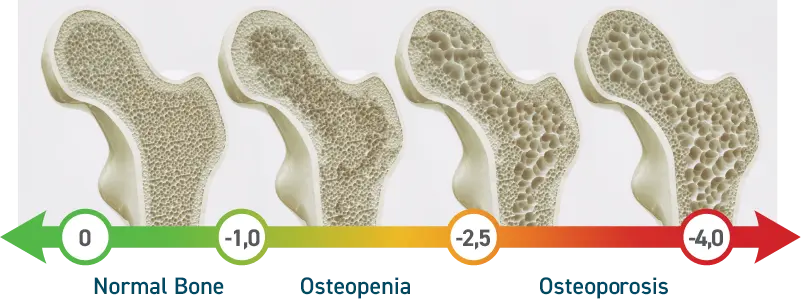
If you are 50 years or older and have risk factors for osteoporosis,
you should speak to your doctor about a bone mineral density test4.
Click here to do the osteoporosis risk factor assessment.
Common sites for
fractures caused by osteoporosis are:1
Hip
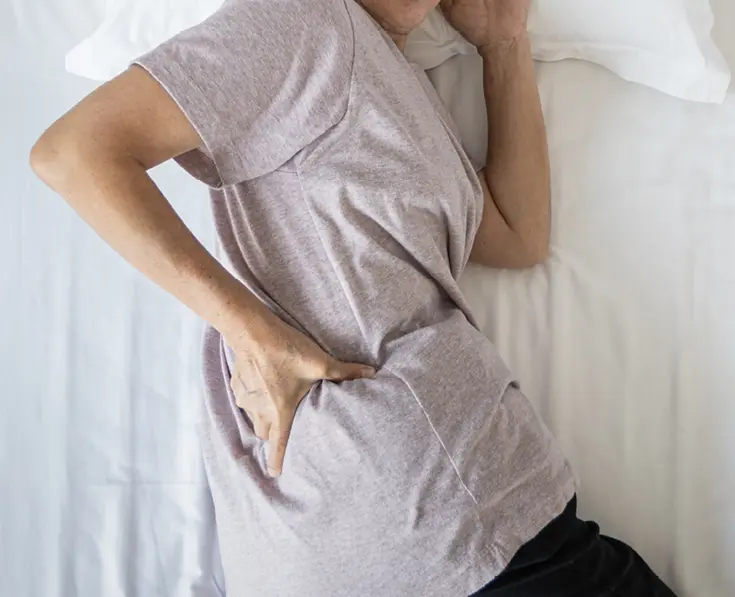
- A hip fracture is one of the most serious types of osteoporotic fractures3
- More than 90 % of hip fractures happen after a fall4
- Hip fractures require surgery and rehabilitation3
- After a hip fracture, about 1 in 4 people die or never walk again1
- More than 50 % of people with a hip fracture will never regain full functional ability to lead an independent life4
- 1 in 3 people require nursing home care in the year after a hip fracture1
- After a hip fracture you are 2,5 x more likely to suffer another fracture5
- Hip fractures can cause physical, emotional and financial strain1
Spine
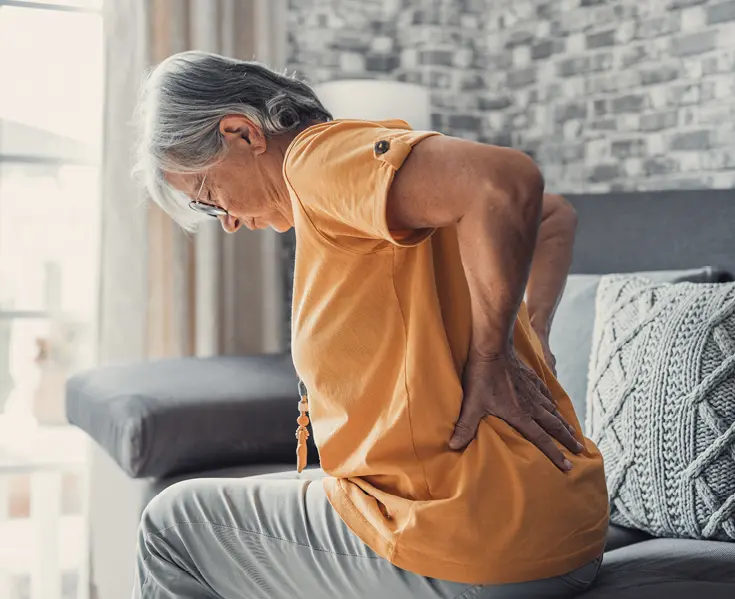
- Vertebral compression fractures are the most common form of osteoporotic fractures6
- Although most spine fractures are initially “silent”, they can result in pain, disability, and deformity5
- Spine fractures can cause kyphosis (humpback) which can make it difficult to bend or reach5
- A fracture in the lower spine can create a sense of pain in nearby areas like the gut area or groin3
- After a spine fracture you are 5 x more likely to suffer another spine fracture5
- 1 in 4 women with a new spine fracture will suffer another spine fracture within 1 year1
- The risk of dying from a spine fracture increases with the number of fractures7
Wrist
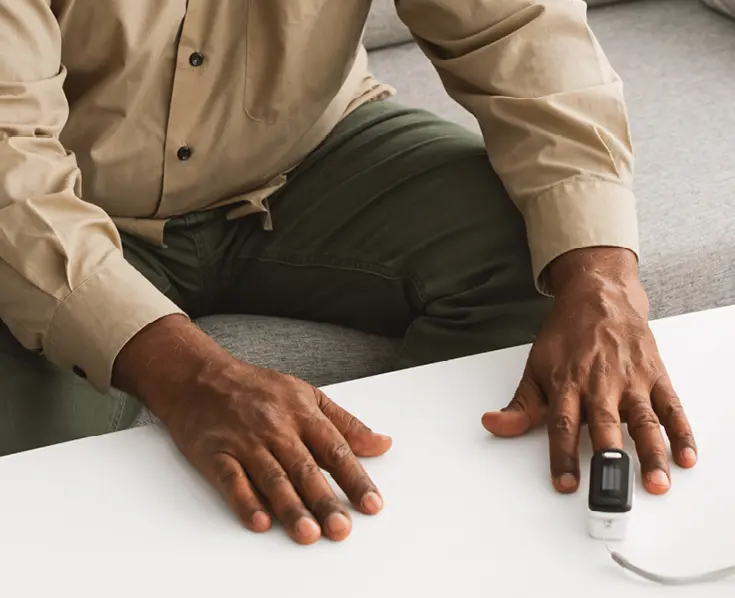
- Wrist fractures are less disabling but can interfere with some activities of daily living as much as hip or spine fractures5
- Most wrist fractures require a cast for at least 6 weeks3
- After a wrist fracture you are almost 2 x more likely to suffer a hip fracture7
Anyone aged 50 years or older who experiences a fracture, from a minor bump or fall should be investigated for osteoporosis.3,4,5
Anyone aged 50 years or older who experiences a fracture, from a minor bump or fall should be investigated for osteoporosis.3,4,5 3Dpg1,4Cpg52,5Epg2361